Sjálfsbjörg lsh. does not object to the revision of the law on the kilometer fee, with the aim of clarifying the legal framework, implementation, and collection of the fee. However, Sjálfsbjörg considers it essential that the review of the law specifically takes into account the situation of people with disabilities who are dependent on their own vehicle for daily life.
The ministry's plan document discusses various exemptions from the fee requirement but does not specifically address the group that needs to use a vehicle due to severe mobility impairment. In Sjálfsbjörg's opinion, this is an important element missing from the impact assessment of the plan. If costs lead people to reduce necessary trips, stop seeking healthcare and rehabilitation, reduce social participation, or have a harder time working, the cost can manifest elsewhere in society.
A car is not an option, but a prerequisite for mobility.
For some people with disabilities, a private car is not a mode of transportation that can be chosen or rejected as convenient. It is a prerequisite for a person to get around and participate in society. This applies, for example, to people who use wheelchairs, power wheelchairs, or other assistive devices.
The person must be able to get to:
- work and study,
- health care and rehabilitation,
- stores and other essential services,
- social activities, sports, and leisure,
- family and friends,
- and other daily errands.
Public transportation is not a viable option for a large group of people with mobility impairments. Even when an accessible bus is available, stops can be inaccessible or the paths to and from them can be difficult or impassable. Difficult weather conditions can also be a barrier for people who use a wheelchair or walker. Therefore, it is important that vehicle tolling legislation does not assume that everyone has a viable choice of transportation.
Equality in the law must take different circumstances into account.
Self-Help believes that when assessing equality, one must look at people's actual circumstances and not just the fact that the same fee is charged to everyone.
A person with a disability who relies on a vehicle does not have the same options as a person who can choose between a private car, public transportation, cycling, or walking. Special attention must be paid to people who have no realistic option to reduce car use without it negatively impacting their ability to access work, healthcare, rehabilitation, and participate in society.
The financial situation of people with disabilities is different.
People with disabilities are not a homogeneous group. Some people are supported mostly or entirely by the Social Security Administration and pension funds. Other people work part-time, and still others work full-time. A person can be full-time employed and still be completely dependent on their own vehicle because of their disability.
Additionally, it should be noted that people with mobility impairments often face other costs related to vehicle ownership, such as the cost of special equipment, vehicle modifications, maintenance, and transporting assistive devices. The per-mile fee thus adds to costs that can already be higher due to a disability.
People with mobility impairments may need to use a vehicle for many short trips that others can make on foot or by public transportation. Thus, the fee can be applied to a number of necessary trips rather than optional driving. This is important when assessing the real-world impact of the charge.
The current vehicle fee system recognizes the distinctiveness of the group.
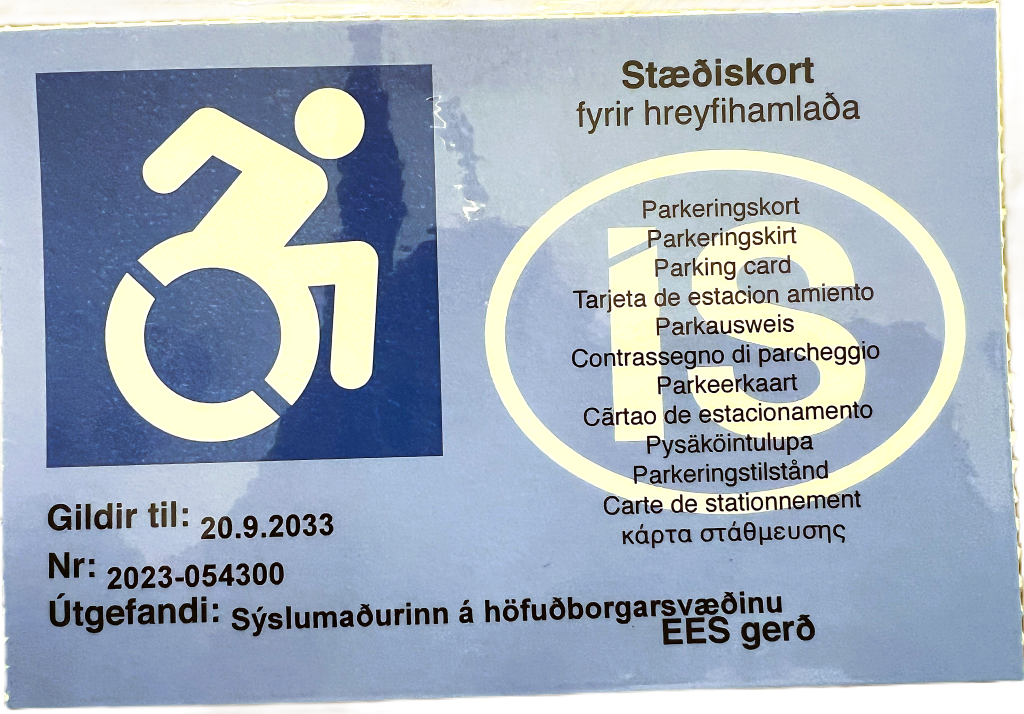
The current regulations on vehicle fees already take into account the situation of people who receive certain payments for disability. The vehicle tax is waived, among other things, for one vehicle owned by individuals who receive a disability allowance, a disability pension, a partial disability pension, sickness and rehabilitation benefits, or a gasoline allowance from the Social Security Administration. The same applies to a vehicle owned by a recipient of disability care payments for a child, provided the conditions are met.
However, this cancellation does not apply to the per-mile fee. The tax specifically states that other vehicle fees, including the per-mile fee, are not canceled even if the vehicle tax has been eliminated.
According to Sjálfsbjörg, it is important to consider this context when a new fee directly related to the use of a vehicle is implemented. The government has already recognized that certain groups need special concessions for their vehicle ownership, and it is therefore logical to consider whether the same reasoning applies to the costs of using the vehicle.
Self-rescue proposes a special arrangement
Sjálfsbjörg proposes that the bill include a special provision for people who are assessed as having a confirmed, significant mobility impairment, who regularly use, for example, a wheelchair or two crutches, and are dependent on a motor vehicle due to their disability. In implementing such a special provision, it must be based on clear and fair criteria regarding mobility impairment and a genuine need for a vehicle. The following options could be considered: a. Elimination of the per-kilometer fee
A kilometer fee will be waived for one vehicle for an individual who meets the defined criteria for significant mobility impairment and a need for a vehicle.
b. Lower per-kilometer fee
A special, lower rate category will be established for vehicles that are necessary due to a disability.
c. Cap on annual fee
A maximum amount will be set for the per-mile fee for a vehicle used due to a severe mobility impairment.
d. Special criterion for specially equipped vehicles
Special consideration will be given to owners of vehicles that have been specially equipped for disabilities, such as with a lift, ramp, hand controls, or other equipment.
Sjálfsbjörg believes the ministry should evaluate these options based on the goals of equality, independence, and community participation.
It is not possible to look solely at the financial impact on the national treasury.
The impact assessment states that the total financial impact of the proposed changes on government revenues is expected to be insignificant.
Self-Help, however, believes it is important that the impact on individuals be assessed separately. Even if the financial impact on the national treasury of a specific exemption for people with disabilities would be small, the impact on individuals can be significant. Therefore, when assessing the impacts, one should consider, among other things, whether the fee could affect people's ability to access healthcare and rehabilitation services, work and study, and participate in social and community activities.
Conclusion and recommendations
Sjálfsbjörg believes that when formulating legislation on a kilometer fee, it must be taken into account that not all vehicle owners have the same choice regarding whether and how much they use their vehicle.
For people with significant mobility impairments, a vehicle can be an essential tool for ensuring independence, employment participation, access to healthcare, and participation in the community.
Self-Help therefore suggests that:
- A special exemption or a lower mileage fee will be introduced for people who depend on a vehicle due to severe mobility impairment.
- The criteria for such an exception are based on a confirmed mobility impairment and a need for a vehicle.
- Consideration shall be given to people's different financial situations, so that the right also extends to people with disabilities who are employed part-time or full-time and are dependent on a motor vehicle due to their disability.
- It will be specifically examined whether the elimination of the vehicle tax and the per-kilometer fee can be harmonized, so that people who have already been granted a disability exemption will not be required to pay the full fee for using their vehicle.
- Organizations of people with disabilities will be included in the ongoing development of the bill and the implementation of a special provision.
Self-rescue believes that the goal of a fair and efficient fare system cannot be achieved in a way that places an undue burden on people who have limited or no alternative for their travel.
Equality does not always mean that everyone pays the same; rather, it can mean taking into account people's different circumstances and their real ability to choose. Sjálfsbjörg requests that the above-mentioned viewpoints be taken into special consideration in the continued development of the bill.