
Legal services and advocacy
How does the government work?
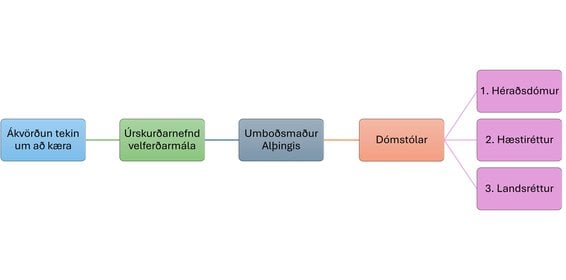
The public has the right to appeal decisions made by the administrative authorities. For individuals with mobility impairments, these can include decisions on the allocation of assistive devices, social security, and grants, to name a few examples. Once a decision has been made to appeal a decision, the following options are available:
Social Welfare Appeals Board
The role of the Social Welfare Appeals Tribunal is to rule on appeals against administrative decisions, as provided for in law. Further information about the tribunal can be found at her homepage.
Ombudsman of the Althingi
If an individual is dissatisfied with the decision of the appeals board, they have the option to appeal the matter further to the Ombudsman of the Althingi. The Ombudsman may be contacted to complain about any kind of decisions, rulings, procedures, and conduct by ministries, government agencies, and other entities that handle the administration of the state. The same applies to municipal councils and other entities that handle administration on behalf of municipalities. Complaints may also be made about decisions by private entities insofar as they have been legally granted public authority to make decisions regarding the rights or obligations of individuals. However, a general requirement is that a case must first be appealed to a higher authority within that institution, such as the Welfare Appeals Board. More information about the Ombudsman's procedures can be found at the organization's homepage.
Courts
The courts are divided into three levels: District Court, Supreme Court, and Court of Appeals. If a person with a mobility impairment is dissatisfied with the outcome of an administrative decision and has exhausted all other appeal options, it is possible to appeal to the courts. You can read all the detailed information on the website. The Judicial District.
Where can I get help to file a complaint?
Legal advice
ÖBÍ – Rights Association
At the ÖBÍ office, people with disabilities and their family members are offered free advice from social workers and lawyers on legal rights. Further information about this service is available at the organization's homepage.
Legal Assistance from Orator – the Law Students' Society of the University of Iceland
Orator provides the public with free legal assistance. The program runs from September to mid-April each year, with the exception of December, when law students take exams at the department. The assistance is provided by phone, making it well-suited for people with mobility impairments. More information can be found at Orators' homepage.
Equality Institute
The role of the Equality Authority is to oversee administrative affairs in the areas of equality policy, equal treatment outside the labor market, and equal treatment in the labor market. Advice and assistance are available for matters concerning, for example, the equal treatment of individuals with disabilities in the labor market. Further information is available at the organization's homepage.
Advocacy and Personal Representatives
A person with a disability who has difficulty advocating for their own interests due to their disability is entitled to a personal advocate. A person with a disability chooses an advocate in consultation with the sheriff. You can read more about personal advocates at Iceland.is.
The tasks of the Ombudsman are now under the Icelandic Human Rights Institute, and more information can be obtained at Home pageof the institution.
We use cookies to ensure the website's functionality and, with your consent, to measure usage and improve our service. You can accept all cookies, reject optional cookies, or choose which cookies you accept.